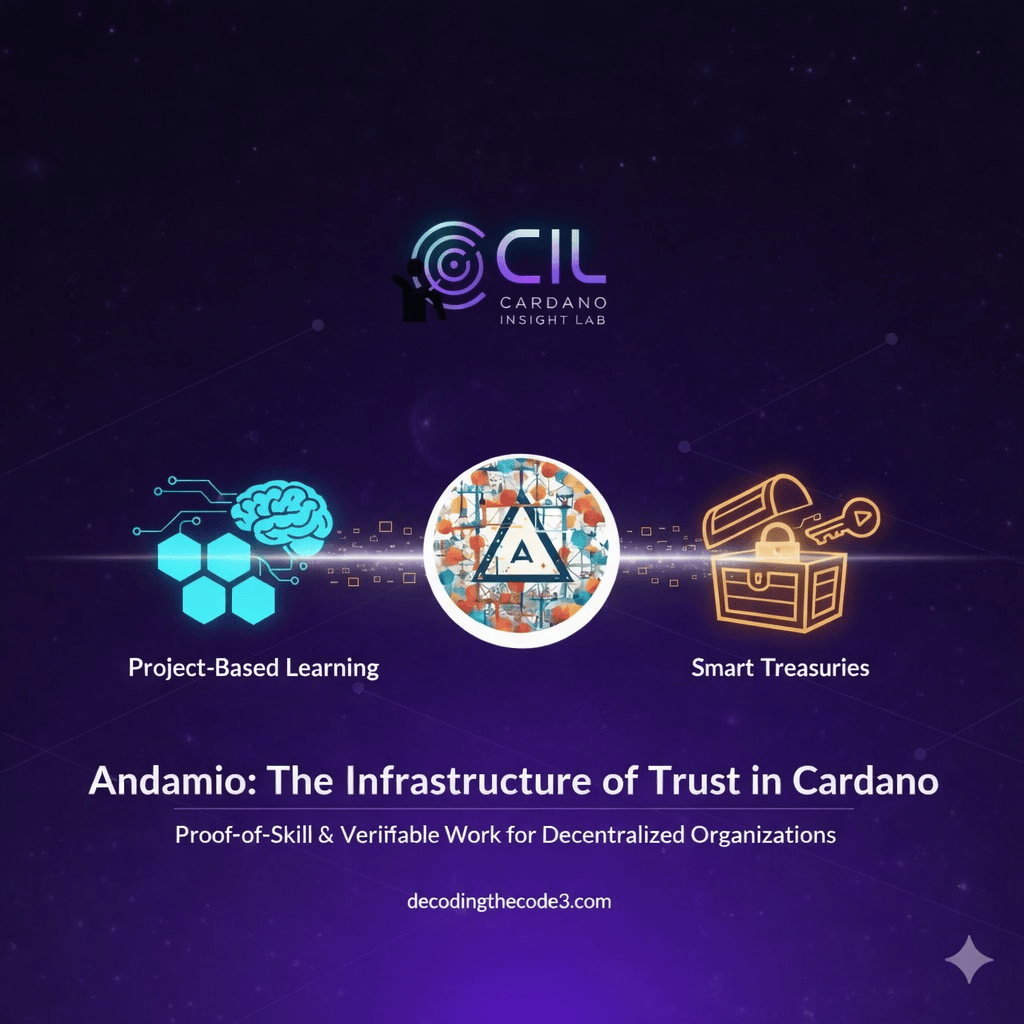
Andamio: The Infrastructure of Trust and the Architecture of Merit in Cardano
Why the future of decentralized organizations depends on systemic verification, not just intent.
In the Cardano ecosystem, the transition to the Voltaire Era has rightfully focused on governance. We speak of voting, community treasuries, representation, and collective decision-making. However, there is an uncomfortable truth that is often avoided: governance without verifiable technical execution is merely sophisticated bureaucracy.
The structural problem of decentralized organizations (DAOs, foundations, technical communities) is not only how to decide, but how to ensure that what is decided is executed with quality, competence, and traceability. In other words: how to ensure that allocated funds are not only voted on correctly but are transformed into real work, useful deliverables, and sustainable value for the ecosystem.
This is where Andamio ceases to be understood as an “educational platform” and must be analyzed as what it truly is: critical infrastructure for coordination, competency validation, and distributed work execution in Cardano.
Andamio as a Protocol, Not a Platform
Andamio was not born to compete with universities or traditional online academies. Its design responds to a deeper need: resolving the gap between a project’s promise and its effective delivery in decentralized environments.
Technically, Andamio operates as a Contribution Management Protocol built on Cardano. Its function is not to teach for the sake of teaching, but to orchestrate learning, work, validation, and compensation under verifiable blockchain rules. If Cardano is the settlement layer, Andamio acts as the competency and execution validation layer.
1. From Static CVs to Living Credentials: Proof of Skill
The hiring model in Web3 is fundamentally broken. DAOs and projects rely on:
Inflated resumes.
Reputations built on social media.
Pseudonymous identities without a verifiable track record.
The result is predictable: high risk, inefficiency, and the misuse of treasuries. Andamio introduces a paradigm shift through Project-Based Learning (PBL) anchored directly to the blockchain.
On-chain Evidence, Not Statements In Andamio, authority does not stem from a title or an institution, but from the resolution of verifiable technical and organizational challenges. Each completed milestone is recorded on-chain using immutable data structures (linked lists), creating a verifiable history of execution.
Systemic Quality Filter If a contributor holds a credential such as Plutus Developer, Governance Reviewer, or Project Contributor issued within Andamio, the ecosystem does not rely on reputation: it relies on cryptographic verification. This directly reduces the risk of funded incompetence and execution failures in community projects.
2. Smart Treasuries: Institutional Hygiene in Spending
One of the most sensitive points in any DAO is fund management. Andamio addresses this through Programmatic Treasury Governance.
Execution-Based Escrow Instead of releasing large amounts of ADA based on milestones described in off-chain documents, Andamio’s project system allows funds to be:
Locked in smart contracts (escrow).
Associated with specific deliverables.
Released only when the system validates work completion or the proven acquisition of a skill.
This is institutional hygiene applied to blockchain public spending. Every ADA released can be traced back to a concrete action or a demonstrated result.
3. Talent Sovereignty and the Contribution Graph
In Andamio, the contributor owns their professional identity. Their progress does not belong to a company, and their credentials are not trapped in a closed platform. This design enables a global contribution graph where the primary currency is proven execution history, not social visibility.
4. Organizational Interoperability and Scalability
Andamio allows multiple organizations to create their own instances without breaking system compatibility. From a systemic perspective, Andamio does not centralize power: it standardizes rules.
5. Origin and Alignment with the Cardano Ecosystem
Andamio emerges from within the Cardano ecosystem, with deep roots in communities like Gimbalabs, recognized for their focus on practical learning and open-source culture. This explains why Andamio is an infrastructure specifically tailored for Cardano’s real needs.
Conclusion: Infrastructure for Trust, Not Promises
Andamio represents an operational trust layer, a bridge between governance and execution, and an architecture of merit based on evidence, not narrative. In a decentralized ecosystem, trust cannot depend on good faith; it must be designed into the system.
Sources and References
The ideas, concepts, and mechanisms described in this article are supported by public documentation, technical proposals, and open debates within the Cardano ecosystem:
Creator of Cardano Insight Lab, an independent observatory focused on blockchain ecosystems, decentralized infrastructure, governance, digital trust, and public-sector adoption.
Her work combines social communication, digital marketing, public relations, and ecosystem analysis to make complex blockchain topics easier to understand for non-technical audiences, public-sector observers, and readers interested in the evolution of decentralized technologies.
Through Cardano Insight Lab, she covers Cardano as a core area of research, while also analyzing broader developments across blockchain infrastructure, regulation, identity, payments, tokenization, DePIN, governance, and institutional adoption.
Her approach is based on clarity, context, and critical analysis, with a focus on explaining blockchain beyond market speculation, promotional narratives, and technical jargon