For decades, States have invested enormous resources in digitization processes. However, in many cases, this digitization has been superficial.
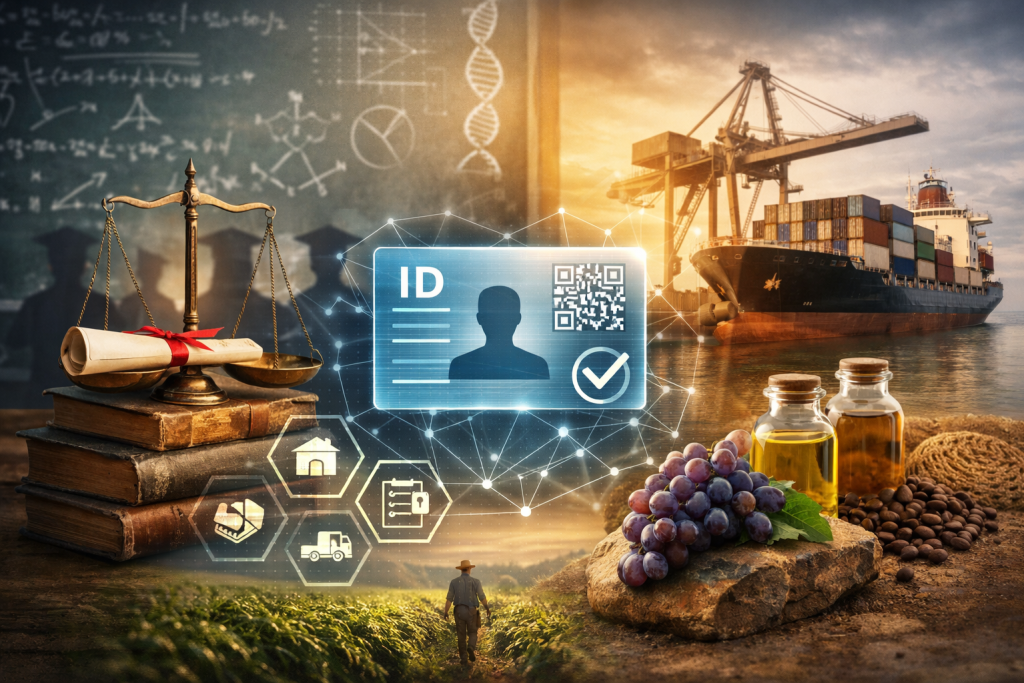
For decades, States have invested enormous resources in digitization processes. Online forms, procedure portals, electronic documents, and administrative management systems have become part of the daily functioning of ministries, universities, and public agencies. However, in many cases, this digitization has been superficial: analog documents have been moved to screens, but the processes that support them have not been transformed.
The result is a bureaucracy that remains slow, costly, and difficult to verify, only now in digital format. PDFs replace paper, but bottlenecks persist: manual validations, unnecessary intermediaries, closed databases, and systems that do not communicate with each other.
The structural problem is not in issuing documents, but in verifying them. Verifying identities, academic degrees, professional certificates, licenses, or official credentials consumes administrative time, public resources, and specialized personnel. In many cases, verifying costs more than issuing. And the more fragmented the State structure is—ministries, decentralized agencies, universities, regional bodies—the greater the friction.
Added to this are well-known risks: documentary fraud, duplication of procedures, delays in critical processes, and difficulties in interoperating between institutions, regions, or countries. In this context, the key question is no longer whether the State should digitize, but how to reduce the structural cost of verification without losing control, legitimacy, or trust.
Self-Sovereign Identity: A Change of Focus, Not an Ideology
Self-Sovereign Identity (SSI) emerges as a response to that specific problem. Not as a technological slogan or an institutional rupture, but as a change in operational focus.
In simple terms, SSI proposes the following: institutions issue verifiable digital credentials, individuals or entities control them, and any third party can validate them immediately, without intermediaries or constant consultations with the issuer.
This point is crucial. SSI does not eliminate the role of the State. On the contrary, it preserves it: public institutions remain the only legitimate authorities to issue official credentials. What changes is that they stop acting as permanent intermediaries every time someone needs to verify data.
To properly understand the scope of the model, it is important to clarify what SSI is not:
- Not radical anonymity.
- Not an anti-state ideology.
- Not “blockchain for everything.”
- Not a replacement for existing legal frameworks.
SSI does not seek to weaken the State, but to reduce the administrative friction that overburdens it today.
How SSI Works, Explained Without Jargon
The SSI model relies on three clearly defined roles:
- Issuer: The institution with the legal authority to issue a credential. It can be a ministry, a university, a regulatory agency, or a certifying body.
- Holder: The person or entity that receives the credential and keeps it under their control. It can be a citizen, a student, a professional, or a company.
- Verifier: Whoever needs to check that the credential is authentic and valid. It can be another public institution, an employer, a foreign university, or an international body.
The fundamental difference from traditional systems is that the credential contains its own proof of validity. It is not necessary to call the issuer, send emails, or consult closed databases every time it is presented. Put simply: the credential “verifies itself.”
Verifiable Credentials and International Standards
For this model to work at a state scale and not get trapped in isolated pilots, there is an indispensable condition: standards. The verifiable credentials used in SSI are based on specifications defined by the World Wide Web Consortium (W3C), the same body that standardizes fundamental Internet technologies. This has profound implications for the public sector.
First, it eliminates dependency on single providers. A State is not tied to a specific company or platform. Second, it allows interoperability between systems, institutions, and countries. Third, it reduces the technological and political risk of adoption. From an institutional perspective, this point is decisive: a government does not adopt a blockchain; it adopts international standards that allow it to evolve without being locked in.
From Atala PRISM to Reusable Infrastructures
The viability of SSI is not demonstrated in theoretical documents, but in real implementations. In the Cardano ecosystem, one of the first deployments of this architecture was Atala PRISM.
Atala PRISM was not conceived as a closed commercial product, but as identity infrastructure based on verifiable credentials and aligned with international standards. Its value was not in the name, but in what it allowed to demonstrate: that SSI can work in complex institutional contexts, at scale, and with real public authorities.
Over time, the focus has evolved toward more open and modular architectures, oriented toward reusable infrastructure. This change responds to a clear logic of the public sector: States do not look for closed solutions, but for systems that can be integrated, adapted, and maintained over the long term.
Public Education: When Identity Becomes Operational
One of the areas where SSI shows its value most clearly is public education. Degrees, certificates, academic records, and accreditations circulate constantly between institutions, employers, and international organizations. However, they still largely depend on paper, PDFs, and manual processes.
In the case of Ethiopia, a system of verifiable digital credentials was implemented to record academic achievements at a national scale. The goal was not to “use blockchain,” but to solve concrete operational problems: reducing fraud, speeding up validations, and facilitating interoperability. In this model:
- Educational institutions issue verifiable credentials.
- Students control them.
- Third parties can validate them immediately.
The impact is tangible: less documentary fraud, reduced administrative costs, greater academic mobility, and better international recognition of degrees. The value of the case is not in the country, but in its replicability.
Traceability and Supply Chains: Identity Applied to Processes
Self-Sovereign Identity is not limited to people. It can also be applied to processes, products, and complete value chains. In sectors such as agriculture, exports, and foreign trade, the challenge is not only knowing who produces but proving what happened, where, and under what conditions.
Cases such as the protection of the authenticity of Georgian wine or commodity traceability initiatives documented by the Cardano Foundation show how certificates of origin and compliance can become verifiable. This reduces counterfeiting, audit costs, and reliance on paper. When identity certifies processes, trust stops being declarative and becomes operational. Traceability stops being an additional cost and becomes integrated into the administrative flow.
Use Cases in Agriculture and Export: When Identity Certifies Origin
Beyond education, one of the areas where SSI shows a direct and measurable impact is in agriculture and export, especially in economies where access to international markets depends on certifications of origin, quality, and regulatory compliance.
In these sectors, the problem is not only producing but demonstrating: demonstrating where a good was produced, under what conditions, by whom, and meeting what standards. Traditionally, this demonstration depends on physical documents, stamps, periodic audits, and fragmented chains of custody. Here, SSI stops being personal identity and becomes process identity.
Agriculture and Supply Chains: Verifiable Traceability
In agricultural chains, each actor generates relevant information: producers, cooperatives, transporters, certifiers, and authorities. However, that information often remains scattered in systems that do not communicate with each other. Initiatives documented by the Cardano Foundation and business infrastructure developments driven by EMURGO have explored the use of verifiable credentials to record key events such as:
- Origin certifications.
- Production practices.
- Health controls.
- Export standard compliance.
In this model, each relevant event can be issued as a verifiable credential, signed by the corresponding entity. These credentials do not replace existing regulation but radically simplify its verification. The result is traceability that does not depend on a single central repository, reduces the need for repetitive audits, and facilitates access for small producers to formal markets. From the State’s perspective, this has a clear effect: better control with less administrative burden.
Authenticity and Designation of Origin: The Case of Georgian Wine
An especially illustrative example is the case of Georgian wine, historically affected by counterfeiting in international markets. Georgia faced a recurring problem: protecting the designation of origin and product authenticity without increasing regulatory costs or slowing down trade.
Through authenticity solutions supported by Cardano infrastructure, a model was explored where:
- Producers record verifiable information about the origin of the wine.
- Certifications are issued digitally and verifiably.
- Distributors, authorities, or consumers can check authenticity without relying on physical documentation.
The value of this approach lies in the reduction of counterfeiting, strengthening the country’s reputation, and increasing trust in export markets. For an exporting State, this is a strategic advantage.
What These Cases Teach the Public Sector
The cases of agriculture and wine show a common pattern: identity is not limited to people, verification moves from paper to the system, and trust stops being declarative to become operational. When production processes can be certified and verified without friction, the State simultaneously improves:
- Control.
- Efficiency.
- International competitiveness.
This makes Self-Sovereign Identity a transversal tool of public policy, applicable to education, trade, and economic development alike.
What a State Gains by Adopting SSI
From a strictly administrative perspective, the benefits are clear:
- Sustained reduction in costs.
- Lower fraud.
- Interoperability between institutions.
- Faster response times.
- Better citizen and business experience.
And perhaps most importantly: this modernization does not require dismantling existing structures. The State maintains authority and control but reduces friction.
Modernizing Trust
In a context of fiscal pressure, transparency demands, and growing institutional complexity, Self-Sovereign Identity appears as a concrete way to modernize trust. Not as a futuristic promise, but as a pragmatic response to a structural problem: verification costs too much, takes too long, and does not scale.
When credentials become verifiable by design, bureaucracy stops being a permanent obstacle and becomes infrastructure. For those seeking to understand how technology can provide real value to the public sector, digital identity is the point where abstraction disappears and the system begins to function.
CIL Conclusion
SSI is not a futuristic promise or a technological fad: it is a practical response to a structural problem of the modern State. The real cost of bureaucracy is not in producing documents, but in verifying them over and over again, between institutions that do not talk to each other and in processes that depend on paper, emails, and manual confirmations.
Self-Sovereign Identity changes the logic: trust is not “managed” as a procedure; it is integrated into the credential. The State does not lose authority; it reaffirms it as a legitimate issuer but stops being the forced intermediary in every validation. This reduces costs, time, fraud, and institutional friction, and opens the door to real interoperability in education, trade, and supply chains.
If Cardano wants to be relevant outside the crypto circle, this is an especially powerful entry point: because it is not about “adopting blockchain,” but about modernizing verification with standards, evidence, and measurable results.

Her work combines social communication, digital marketing, public relations, and ecosystem analysis to make complex blockchain topics easier to understand for non-technical audiences, public-sector observers, and readers interested in the evolution of decentralized technologies.
Through Cardano Insight Lab, she covers Cardano as a core area of research, while also analyzing broader developments across blockchain infrastructure, regulation, identity, payments, tokenization, DePIN, governance, and institutional adoption.
Her approach is based on clarity, context, and critical analysis, with a focus on explaining blockchain beyond market speculation, promotional narratives, and technical jargon
- Who the Hell Let a Journalist into a Hackathon? – 27 de July de 2026
- Blockchain Enters Wall Street: The Revolution That Ended Up Wearing a Suit – 1 de May de 2026
- Blockchain and International Payments: The Problem Is Not Moving Money, It Is Proving What Happened – 30 de April de 2026