Cardano Today: Market Jitter, Not Technical Crisis
The discomfort currently perceived around Cardano (ADA) does not stem from a network collapse or a security failure. It is the result of a combination of market factors, perception, and structural complexity that, when poorly explained, turn into noise. Separating technical foundations from simplified narratives is key to understanding the real state of the ecosystem.
1. Stagnant Price and “Opportunity Cost”
ADA has shown slower price action compared to other assets in the crypto market. While some chains have experienced rapid recoveries or aggressive speculative movements, Cardano has moved with caution.
This behavior does not indicate a technical problem, but it does generate a very specific feeling: opportunity cost. In simple terms, opportunity cost is not necessarily losing money, but the sensation that capital is immobile while other assets are moving. For many investors both institutional and retail—this translates into anxiety, even when the network’s fundamentals remain intact. Here, the dominant factor is not engineering, but market psychology.
2. TVL and the “Ghost Chain” Narrative
One of the most repeated arguments against Cardano is its relatively low TVL (Total Value Locked) compared to other ecosystems. To understand why this generates so much noise, we must first clarify the metric.
What is TVL? TVL (Total Value Locked) indicates how much capital is deposited in smart contracts, primarily in DeFi applications such as lending or decentralized exchanges. In simple terms: it measures how much money is “working” within a blockchain’s applications.
A high TVL is often interpreted as success, but it is an incomplete metric:
It does not measure liquid staking (which in Cardano does not require forced locking).
It does not measure the number of active wallets or ongoing development.
It does not measure institutional or educational adoption.
The market tends to prefer easily comparable metrics, even if they do not tell the whole story. Labeling Cardano a “ghost chain” based solely on TVL is a methodological oversimplification.
3. Voltaire and the Discomfort of Real Governance
Cardano is in the midst of its transition toward full decentralized governance, known as Voltaire. This means the community will take over decisions regarding the treasury and protocol evolution.
This process introduces something the market usually punishes: uncertainty. Not because the system is poorly designed, but because it is complex, not immediate, and lacks clear precedents at this scale. For the average investor, this complexity translates into distrust not due to flaws, but due to a lack of understanding of how decisions are made. Here, the issue is cognitive and communicational, not technical.
4. EUTxO: A Different Model, Not an Error
The deployment speed of applications on Cardano is often a point of frustration, directly linked to its technical architecture.
What is EUTxO? The Extended Unspent Transaction Output (EUTxO) model is how Cardano processes transactions. Without the jargon: each transaction works as an independent piece with clear rules from the start. This makes the system more predictable and secure but demands more rigorous programming.
In contrast, blockchains like Ethereum use an Account Model (similar to a bank account), which is more flexible for quick experimentation but more prone to errors and unexpected side effects. The practical result is that Cardano moves slower in dApp deployment but does so with greater control. The market, accustomed to immediacy, often mistakes rigor for inefficiency.
5. Regulation: A Persistent Shadow
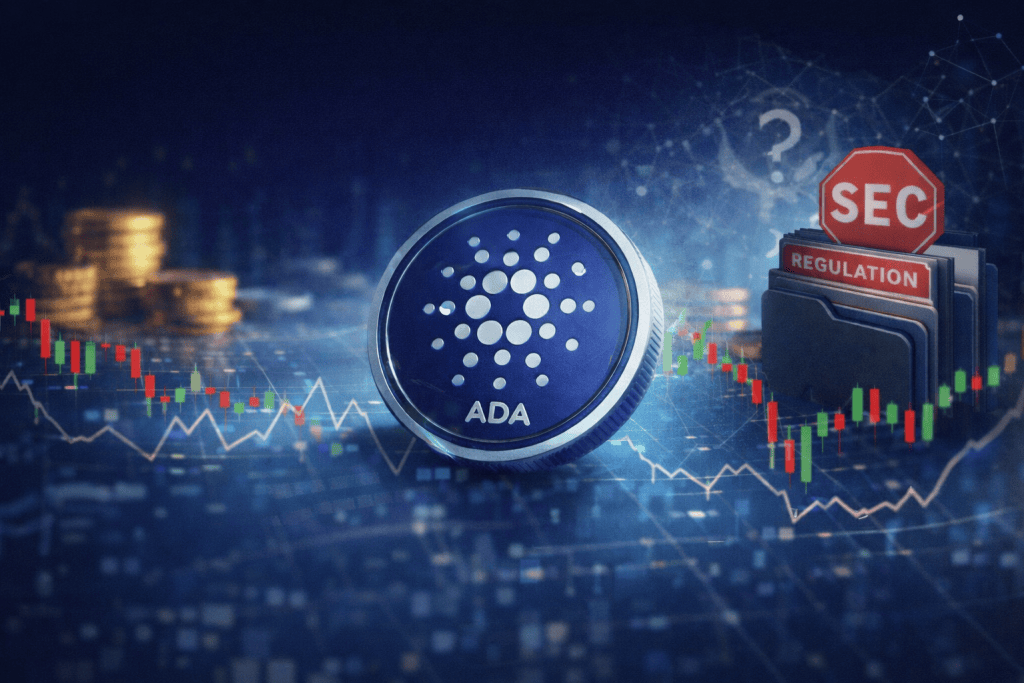
While not exclusive to Cardano, ADA’s mention in past regulatory discussions especially in the US continues to weigh on risk perception. This is not an active technical threat, but a factor influencing exchange decisions and institutional appetite. The market reacts more to perceived legal risk than to legal nuances.
CIL Conclusion: Impatience, Not Collapse
The current nervousness surrounding ADA is not a response to a technical vulnerability. It is a response to a combination of factors: slow price action, the oversimplified use of TVL as an absolute yardstick, and a constant pressure for immediate results.
In other words: the market is punishing patience, not stability. Mistaking slowness for failure is a convenient narrative, but it is not a serious analysis. Cardano remains one of the most stable networks in the ecosystem; what is in crisis is not its technology, but the market’s tolerance for long and complex processes.
Creator of Cardano Insight Lab, an independent observatory focused on blockchain ecosystems, decentralized infrastructure, governance, digital trust, and public-sector adoption.
Her work combines social communication, digital marketing, public relations, and ecosystem analysis to make complex blockchain topics easier to understand for non-technical audiences, public-sector observers, and readers interested in the evolution of decentralized technologies.
Through Cardano Insight Lab, she covers Cardano as a core area of research, while also analyzing broader developments across blockchain infrastructure, regulation, identity, payments, tokenization, DePIN, governance, and institutional adoption.
Her approach is based on clarity, context, and critical analysis, with a focus on explaining blockchain beyond market speculation, promotional narratives, and technical jargon